Sub-Total: $0.00
!DOCTYPE html>
EDC Flashlight Comparison — 30+ Lights Rated | 381EDC
Click column headers to sort
381 EDC Knowledge Base
EDC Flashlight Comparison Chart
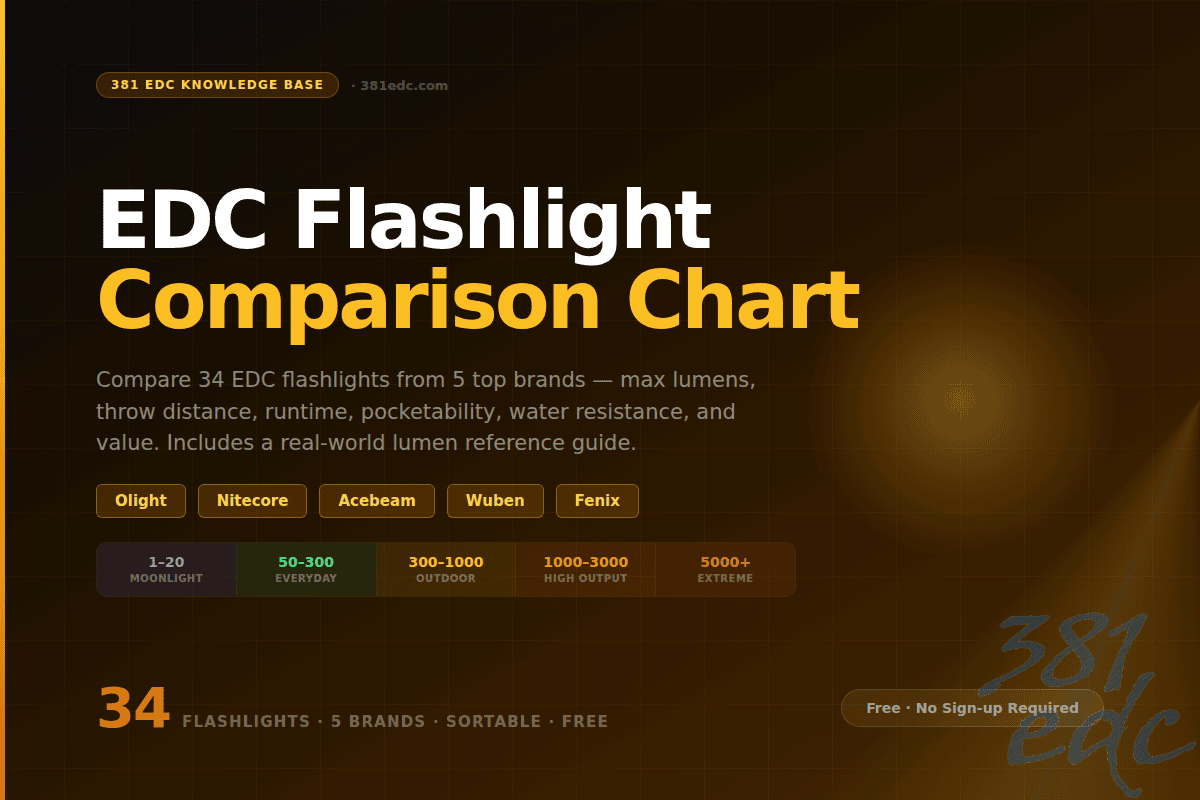
The complete EDC flashlight comparison — 30+ models from Olight, Nitecore, Acebeam, Wuben, and Fenix rated across max lumens, throw distance, beam type, battery platform, waterproofing, and overall value. This EDC flashlight comparison chart covers every category from keychain carry lights to high-output tactical models.
EDC Flashlight Lumens Explained — What the Numbers Actually Mean
Lumens measure total light output. In our EDC flashlight comparison, every model is rated for max lumens — but more lumens does not always mean better. The right output depends entirely on what you're doing. Here's a practical real-world reference for choosing your everyday carry flashlight:
1–20
Moonlight
Map reading, preserving night vision, not waking others
20–150
Low / Everyday
Reading menus, finding keys, indoor navigation
150–500
Medium
Walking a trail, parking lot, garage work, camping
500–1500
High
Outdoor search, signaling, tactical use, cycling
1500–5000
Very High
Search and rescue, large area lighting, professional use
5000+
Extreme
Maximum output — brief bursts, search operations, specialty use
How to use this EDC flashlight comparison chart: Click any column header to sort. Use the filter buttons to narrow by brand or use category. Click a model name to jump to its full profile. Ratings are on a 1–10 scale — higher is always better. Max lumen output is peak turbo; sustained output is typically lower after 30–60 seconds due to thermal regulation.
Interactive EDC Flashlight Comparison Chart — Sort & Filter 30+ Models
| Model | Brand | Category | Max Lumens |
Throw (meters) |
Runtime | Pocketability | Water Resistance |
Value |
|---|
Model Profiles — Full Details
Beam Types Explained — EDC Flashlight Buying Guide
Flood beam — wide, even illumination across a broad area. Best for close-range tasks, camp lighting, and indoor use. Poor throw but excellent peripheral coverage.
Spot beam — tight, focused hotspot that throws light far. Best for identifying objects at distance, trail navigation, and tactical use. Poor close-range peripheral coverage.
Hybrid/Combo beam — a reflector or TIR optic that produces a defined hotspot with usable spill. The most versatile EDC beam profile. Most modern EDC lights use this.
Dual-mode (Flood + Spot) — separate flood and spot emitters or optics, switchable or simultaneous. Found on premium lights like the Olight ArkPro and Marauder Mini 2. Maximum versatility at higher cost.
📐 About our ratings: Lumen and throw figures in this EDC flashlight comparison follow ANSI/NEMA FL1 standards — the industry benchmark for measuring flashlight output, beam distance, runtime, and water resistance. Peak lumen claims from manufacturers that don't specify FL1 compliance may be measured differently.
Battery Platforms in This EDC Flashlight Comparison
18650 — the workhorse of serious flashlights. Large capacity, widely available, high output capability. Most quality EDC lights use 18650 cells. Some require proprietary cells; others accept standard 18650s.
21700 — larger than 18650, higher capacity, better sustained output. Found in premium high-output lights. Provides longer runtime between charges at high outputs.
18350 — half-length 18650. Used in compact EDC lights for size reduction at the cost of runtime. Common in Olight Baton series compact variants.
AA / AAA — disposable alkaline or lithium cells. Widely available everywhere — gas stations, hardware stores, airports. Ideal for backup lights and travel. Lower output ceiling than lithium-ion.
Built-in rechargeable — internal battery, charged via USB-C or proprietary magnetic charging. Most convenient for daily use. Cannot be swapped in the field if depleted.
Proprietary — brand-specific cell required. Olight uses proprietary cells on some models. Higher performance in a smaller package, but requires brand-specific replacements.
EDC Flashlight Comparison — Frequently Asked Questions
How many lumens do I actually need for everyday carry?
For most everyday tasks — finding things in the dark, navigating parking lots, reading labels — 200–500 lumens is more than sufficient. A light in the 500–1,000 lumen range covers virtually every real-world EDC scenario including outdoor use and self-defense situations. Lights above 1,500 lumens are impressive for demos but their turbo modes typically only sustain for 30–90 seconds before thermal regulation steps them down to a lower sustained output. Don't buy lumens you'll never use at the expense of battery life and size.
What is the difference between Olight, Nitecore, Fenix, Acebeam, and Wuben?
Olight leads in innovation and polish — the best UI design, magnetic charging convenience, and widest product range. Some models use proprietary batteries. Nitecore offers excellent value and a very wide range from ultra-compact to high-output, with good use of standard batteries. Fenix is the premium build-quality leader — known for durability, consistent specs, and professional-grade construction. Acebeam specializes in high-output and high-throw lights — the best beam distance in compact packages. Wuben is the value leader — standard battery compatibility, USB-C charging, and honest specs at lower price points than the other brands.
What does IPX8 mean on a flashlight?
IPX8 means the light is rated for continuous immersion in water beyond 1 meter (the exact depth and duration is specified by the manufacturer — typically 1–2 meters for 30 minutes). This is the highest common waterproofing rating for EDC flashlights and means the light will survive rain, submersion, and water carry. IPX7 covers temporary immersion to 1 meter for 30 minutes. IPX4 covers splashing from any direction. For EDC carry, IPX7 or IPX8 is recommended.
What is thermal regulation and why does it matter?
Thermal regulation (also called step-down or temperature regulation) is an automatic brightness reduction that activates when a flashlight's emitter reaches a temperature threshold — typically around 55–60°C. This prevents damage to the LED and battery. In practice, it means a light rated at 1,500 lumens on turbo may step down to 600–800 lumens after 60–90 seconds of continuous high use. This is normal and expected — all quality flashlights do it. When evaluating a light's real-world performance, the sustained output after step-down is often more meaningful than the peak turbo number.
Should I choose a light with magnetic charging or USB-C?
Magnetic charging (Olight's MCC system) is extremely convenient for daily charging — just snap the cable to the tail cap. The downside: if you forget your proprietary cable, you can't charge. USB-C charging is universally compatible — any USB-C cable works, which means you can charge with phone chargers, laptops, power banks, and cables found anywhere. For travel and backup reliability, USB-C wins. For daily home/office use, magnetic charging is more convenient. Many newer premium lights now offer USB-C, and Olight has been adding it to their lineup.
What is the best EDC flashlight for self-defense?
For self-defense use, prioritize: a dedicated strobe mode accessible quickly, output above 500 lumens (enough to temporarily blind and disorient), a tail switch for one-handed activation, and a compact body that works with a cigar grip. The Olight Warrior Mini 3 (1,750 lumens, dual-switch tactical design) and Nitecore EDC27 are well-regarded tactical EDC choices. A 500–1,000 lumen light with instant strobe access is more practical for self-defense than a 5,000 lumen light that is too large to carry daily.
Are proprietary batteries a dealbreaker?
Not necessarily. Olight's proprietary cells are high quality and designed to maximize performance in their specific lights. For daily home or office carry, proprietary batteries are rarely an issue — you charge at home and rarely need a swap. The concern arises in extended field use or travel where you may not have your charger. If you want field-replaceable batteries from any source, look for lights that accept standard 18650, 21700, or AA cells — Nitecore, Fenix, Acebeam, and Wuben all offer models with standard battery compatibility.
What is CRI and does it matter for EDC?
CRI (Color Rendering Index) measures how accurately a light source renders colors compared to natural daylight (CRI 100 = perfect). Most standard flashlight LEDs are 65–75 CRI — colors look slightly washed out or blue-shifted. High CRI lights (90+) render colors more naturally and accurately. This matters for trades work, medical use, identifying objects by color, and general visual comfort in extended use. For basic EDC, standard CRI is fine. For detail work, medical, or automotive use, high CRI is worth seeking out. Acebeam and some Nitecore models offer high-CRI options.
🔥
Also in the Knowledge Base: Knife Steel Heat Treatment Explained
Carrying an EDC knife alongside your light? Learn how HRC hardness, tempering, and cryogenic treatment determine how your blade actually performs — in plain English.
Shop EDC Flashlights at 381 EDC
Browse the full flashlight catalog at 381 EDC — EDC lights, tactical lights, and accessories from the top brands in the industry.
Shop All Flashlights → All Knowledge Base Guides →© 2026 381 EDC · 381edc.com · St. Charles, Missouri · Part of the EDC Knowledge Base